
You’ve had imaging done. Maybe X-rays, maybe an MRI. The report comes back with findings, your doctor points at the screen, and you walk out with a diagnosis that explains the picture but not the pain. Or the opposite happens: the scan looks clean, nothing remarkable, and you’re left wondering why every morning still starts with the same dull ache spreading across your lower back and into your hip.
Here’s something I tell patients regularly: the place where pain is felt is not always the place where pain begins. This concept, referred pain, is one of the most clinically important and most consistently under-explained phenomena in musculoskeletal medicine. Understanding it changes how you think about your back, your body, and why treatments that target only the symptomatic site so often fall short.
What “Referred Pain” Actually Means
Referred pain is real, somatic pain that arises from a structure in one location but is perceived by the brain as coming from somewhere else. This is not psychosomatic. It is not exaggerated. It is a product of how the nervous system is wired.
The mechanism involves a concept called convergence. Sensory neurons from different body regions often converge on the same second-order neurons in the spinal cord. When the brain receives a signal at that convergence point, it cannot always distinguish which of the contributing sources triggered it. It assigns the sensation to the most familiar or most peripheral of those sources, which is frequently not the one that is actually irritated.
The most famous example is cardiac referred pain: a heart attack causes left arm and jaw pain because the sensory neurons from the heart share spinal cord relay stations with neurons from those regions. The arm is not injured. The jaw is not injured. The brain simply misreads the signal’s origin.
The same process happens constantly in the spine, pelvis, and extremities, and it is far more common as a source of referred pain symptoms than most patients realize.
Common Back Pain Sources That Aren’t Where the Pain Lives
Facet Joints
The facet joints are small paired joints at the back of each spinal segment. They guide movement and bear a portion of compressive load. When they become inflamed, arthritic, or irritated, they generate referred pain patterns that are well-documented and predictable.
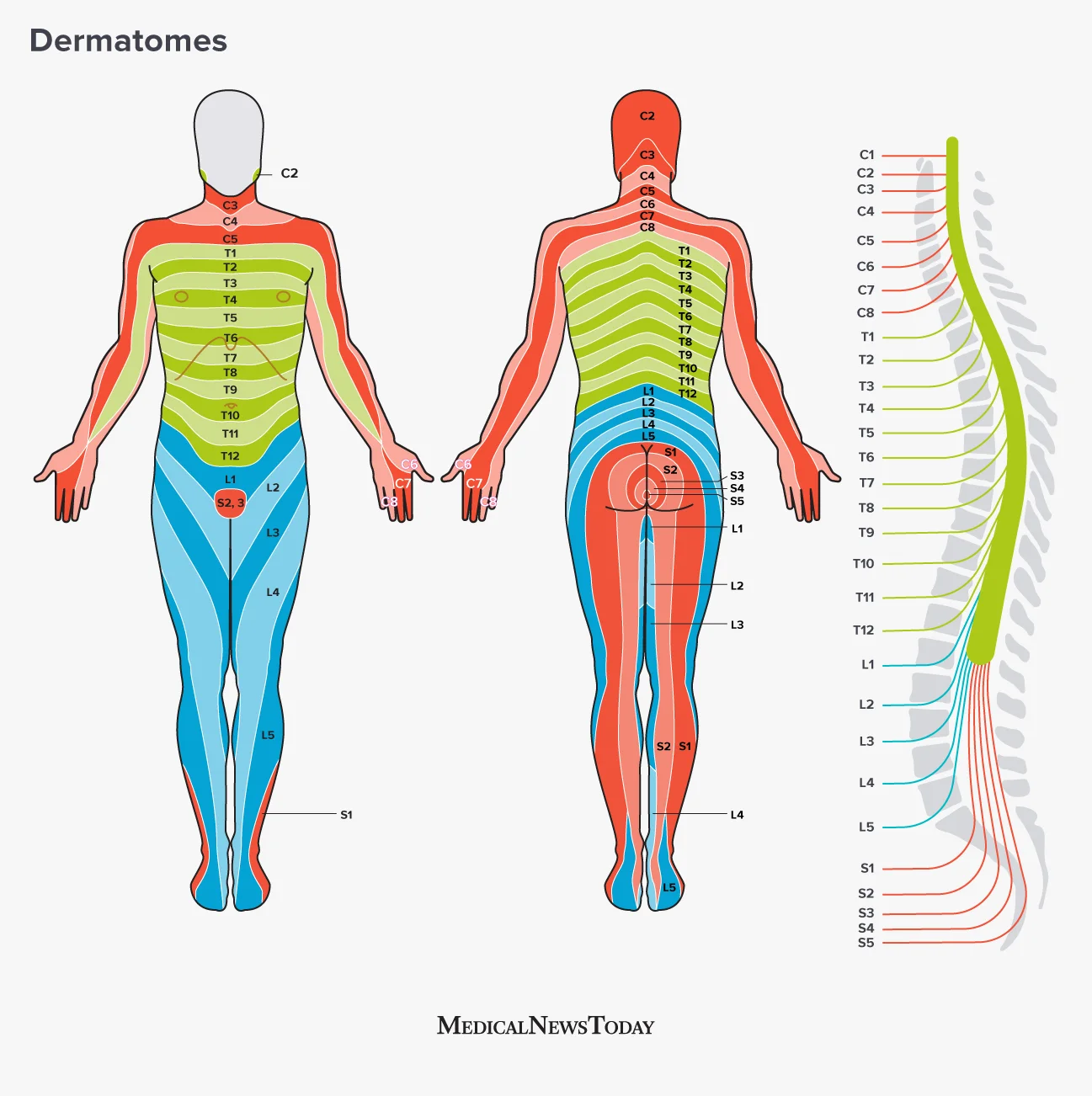
Cervical (neck) facets commonly refer pain to the head, upper trapezius, and shoulder blade. Lumbar facets, particularly L4-L5 and L5-S1, refer into the buttock and posterior thigh. This pattern mimics sciatica well enough that the two are frequently confused. The critical difference: true radicular pain from nerve compression follows a dermatomal strip, often with associated numbness or tingling. Facet-mediated referred pain is typically described as deep, achy, and diffuse, without the electrical or burning quality of nerve involvement.
The Sacroiliac Joint
The sacroiliac (SI) joint, where the sacrum meets the ilium on each side of the pelvis, is a known generator of referred pain symptoms affecting the low back, groin, posterior thigh, and occasionally even the calf. Studies using provocation and diagnostic injection have confirmed that SI joint dysfunction accounts for roughly 15 to 25 percent of chronic low back pain cases.
Patients often describe SI pain as a back pain source on one side, worse with prolonged standing, transitioning from sitting to standing, or lying on the affected side. Because the pain can radiate below the knee, it is frequently attributed to disc herniation without adequate evaluation of the SI joint itself.
Trigger Points in the Quadratus Lumborum and Gluteus Medius
The quadratus lumborum (QL) is a deep muscle connecting the lower rib, the lumbar transverse processes, and the iliac crest. It is one of the most common referred pain sources for low back pain. Active myofascial trigger points in the QL can produce pain along the sacroiliac region, the crest of the hip, and into the anterior groin, mimicking hip pathology or even kidney discomfort.
The gluteus medius, a muscle on the lateral hip, refers pain into the low back and sacral region in a pattern that overlaps almost perfectly with the complaint patients describe as “my lower back on one side.” When a patient shows me exactly where their pain is with the back of their hand pressed against the SI joint, and they have no neurological signs, gluteus medius trigger points are always on my short list.
Thoracic Dysfunction Referring to the Chest or Abdomen
Thoracic facet dysfunction and rib-vertebral joint irritation are significant and frequently missed referred pain sources. Thoracic spine pathology can produce pain in the anterior chest wall, mimicking cardiac or pulmonary symptoms. It can refer into the upper abdomen, mimicking gastric pain. This is a clinical pattern well-recognized in manual medicine literature, and it is the reason a thorough examination of the thoracic spine is part of a complete assessment whenever a patient presents with chest or abdominal discomfort that has had cardiac and gastrointestinal causes ruled out.
Why This Gets Missed So Often
Imaging studies show structural findings. Structural findings attract clinical attention. If an MRI shows a disc bulge at L4-L5, and the patient has low back and hip pain, the two are assumed to be causally linked. Sometimes they are. Often they are not.
Population studies have consistently shown that disc bulges, facet hypertrophy, and degenerative changes are present in a substantial percentage of people with no pain at all. A 2015 systematic review in the American Journal of Neuroradiology found that by age 50, more than 60 percent of asymptomatic adults have disc bulges on MRI. The structure is not the diagnosis. The clinical picture is the diagnosis.
When a treatment plan is built around the structural finding rather than the pain mechanism, it often produces incomplete or temporary results. That is not because treatment failed. It is because the treatment addressed the wrong target.
How We Approach This at Our Clinic
At Gentle Care Chiropractic in West Linn, I approach every pain presentation as a pattern-matching exercise before it becomes a treatment plan. That means going through a systematic assessment: where the pain is felt, what movements or positions provoke or relieve it, whether there are neurological signs, whether orthopedic provocation tests reproduce the pain, and whether palpation of candidate structures reproduces the referred pattern.
A positive FABER or FADIR test pointing to hip pathology in a patient with “low back pain” changes the treatment direction entirely. A positive Yeoman’s test or Gillet’s test in that same patient points toward the SI joint. Deep palpation of the QL or piriformis that reproduces the exact symptom the patient has been trying to describe for months is both diagnostically useful and, for the patient, often a significant moment of clarity.
This matters because treatment that addresses the actual pain source produces better and more durable outcomes. Chiropractic manipulation of a hypomobile SI joint, soft-tissue work on a QL or gluteus medius loaded with trigger points, or targeted mobilization of a restricted thoracic segment can resolve a complaint that has not responded to lumbar-focused care, not because a new miracle was performed, but because the right structure was finally being addressed.
If you’re curious how chiropractic adjustment works at a mechanical and neurological level, that post goes deeper into the mechanisms.
What Referred Pain Is Not
It is worth being clear about what referred pain is not, because the concept is sometimes used carelessly.
Referred pain is not radiculopathy. Radiculopathy involves actual nerve root compression or irritation, producing neurological symptoms along a dermatomal distribution. Numbness, weakness, and reflex changes accompany true radiculopathy. Disc herniation and nerve compression are a different clinical entity from the somatic referred pain patterns described here.
Referred pain is also not a reason to dismiss an imaging finding as irrelevant. Sometimes the structure found on imaging is exactly the pain source. The point is not to ignore structural findings but to confirm the clinical correlation before centering all treatment on them.
And referred pain from musculoskeletal structures does not excuse the clinician from screening for visceral sources. Kidney pathology, endometriosis, aortic aneurysm, and other non-musculoskeletal conditions can produce back pain that mimics spinal dysfunction. Red flags, including unexplained weight loss, fever, night pain that does not change with position, and pain in the setting of known malignancy, always warrant medical referral before chiropractic care is pursued.
Putting It Together for Your Own Care
If you have been living with back pain, hip pain, or pelvic pain that has not responded to treatment, or that has been explained by imaging findings you were never quite sure were the real answer, a referred pain evaluation is worth having. Our rehabilitation approach often incorporates this kind of multi-structure assessment for patients whose pain patterns don’t fit a single-source explanation.
At Gentle Care Chiropractic in West Linn, Oregon, we take time to trace where pain is actually coming from before we decide how to treat it. That extra step makes a meaningful difference in outcomes.
If you have questions about referred pain or want to find out whether a source-focused evaluation is a good fit for your care plan, we’re easy to reach. That’s what we’re here for.
Dr. Tristan Santiago Maceiras is a Doctor of Chiropractic at Gentle Care Chiropractic in West Linn, Oregon, specializing in musculoskeletal medicine, MVA recovery, and integrated care.
Frequently Asked Questions
Can referred pain symptoms from a muscle or joint feel exactly like nerve pain?
Yes, and this is one of the most common sources of diagnostic confusion. Facet joint-referred pain and trigger-point-referred pain can produce deep, spreading discomfort that travels into the leg and mimics sciatica closely. The distinction lies in the quality (achy and diffuse vs. electric and dermatomal), the absence of neurological signs like numbness or weakness, and the response to clinical provocation tests. An experienced clinician can usually distinguish the two without imaging.
How does a chiropractor identify the true back pain source when the pain is not where the problem is?
Through a combination of orthopedic provocation tests, movement analysis, and direct palpation. If pressing on the quadratus lumborum reproduces your exact hip pain, that is diagnostically meaningful. If a passive hip test reproduces low back pain, the hip joint becomes a candidate. The examination is designed to provoke and reproduce the symptom from candidate structures rather than simply mapping where you hurt.
Is referred pain always musculoskeletal, or can organs cause it too?
Organs absolutely cause referred pain, and this is an important clinical consideration. The kidneys, gallbladder, uterus, and aorta can all produce back or abdominal pain without localizing accurately to the organ itself. This is why a complete intake history and red-flag screening are essential before proceeding with spinal treatment. When organ-based referred pain is suspected, medical evaluation takes priority.
If I’ve had a normal MRI, does that mean referred pain from a joint or muscle is more likely?
A normal MRI rules out disc herniation and certain structural findings but does not assess the functional status of joints, ligaments, or muscles. Facet joints, the sacroiliac joint, myofascial trigger points, and ligament sprains can all generate significant referred pain symptoms without any finding on standard MRI. A normal scan is useful information. It does not mean nothing is wrong.
Can referred pain be treated, or is it something patients just manage?
It is very much treatable. When the pain source is accurately identified, whether it’s a dysfunctional facet joint, an irritated SI joint, or a loaded myofascial trigger point, targeted manual therapy, joint mobilization, or soft-tissue treatment directed at that source can provide substantial and lasting relief. The key is identifying the right target first, which is exactly where this kind of evaluation adds the most value.
Dealing with this in West Linn, Lake Oswego or Oregon City?
Same-week appointments. PIP and most insurance accepted.